Making earth a greater place every moment

Recycling Process
Step 1 – Collection of Bottles
The first step in PET recycling is the collection of bottles. A large portion of collection is done via "open-market" recycling where the rag-pickers pick-up the PET bottles and sell them to collection centers.
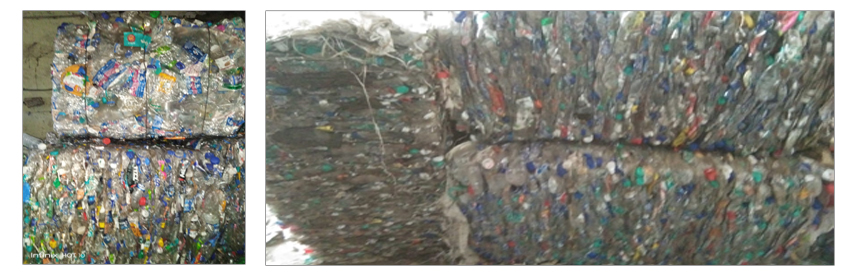
Once collected and sorted at these centers, the plastic bottles are baled into large compacted bundles (pictured below) and sent to a local PET bottle washing plant for processing into "hot-washed" PET flakes.
Step 2 – De-baling & Sieving
When the plastic bottles arrive at a PET recycling / washing plant, they are usually in large bales that have already been separated by color. The main goal is to recover these dirty plastic bottles and thoroughly clean them so they can be reused.
For a standard, fully automated PET washing line, the first piece of equipment is a "de-baling machine" that takes large, compacted bales of PET bottles and breaks them loose so the bottles flow freely onto a belt conveyor which leads to a large trommel / Sieving machine.
The trommel, a large rotating tunnel with holes smaller than the standard PET bottle, removes small contaminants such as broken glass, metals, rocks, paper/cardboard, etc., allowing PET bottles to move forward in the washing line.
Step 3 – Pre-sorting & Label Separation
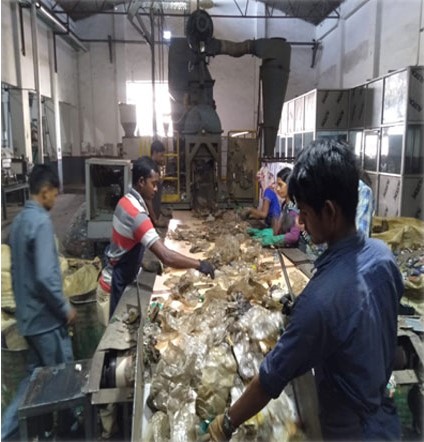
An accurate way to remove contaminants from the material stream is via manual sorting. For instance, a milk bottle (made of HDPE) would have made it past the trommel process, however, this is considered a contaminant since it's not PET.
From here the sorted bottles are conveyed into the label scrapper. Heat shrink labels of PET bottles can't be removed through bottle pre-washing. Hence in the label scrapper bottle surface is scrapped and labels are removed off the bottles. Then the bottles and labels are separated using adjustable wind force.
Step 4 – Bottle Pre-washing
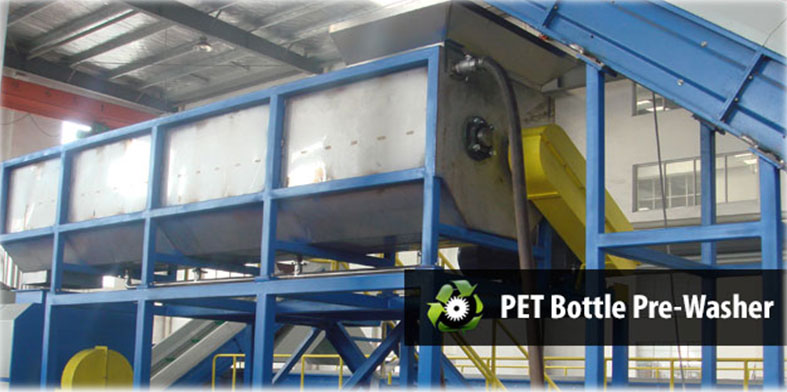
Using automated circulation and continuous feeding, high temperature chemical water is supplied to wash PET bottles. This ensures removal of labels, dirt, glue, metal, rubber and other impurities on bottle surfaces.
High temperature washing can make changes in the appearance of PVC bottles, making it easily distinguishable from PET bottles and therefore simplifying the manual sorting process.
Step 5 – Manual Sorting
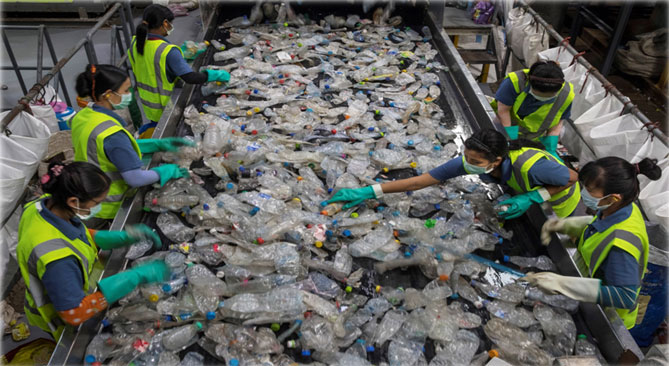
Pre-washed bottles are then placed on widened long belts where attendants manually remove PVC, PC bottles, bottles with metal caps, HDPE bottles and other degraded bottles which are not fit for reuse. Only first grade PET bottles are allowed to enter the grinder for further process.
Step 6 & 7 – Wet Grinding & Hot Washing
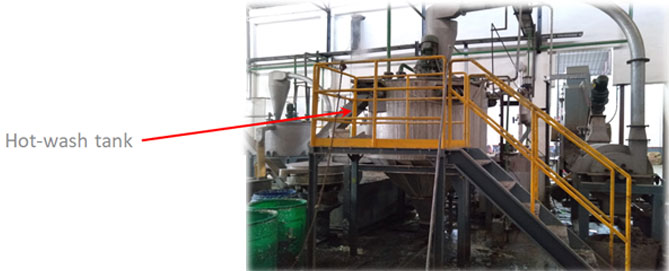
The most efficient way of converting PET bottles into flakes is the wet grinding. The granulator is used as a washing machine. Due to the mechanical action during the cutting process, friction in the cutting chamber allows the use of water for washing during size reduction.
The result is always convincing as the leftover impurities on the inner bottle surface are completely removed during wet grinding.
Step 8 – Rinsing & Drying
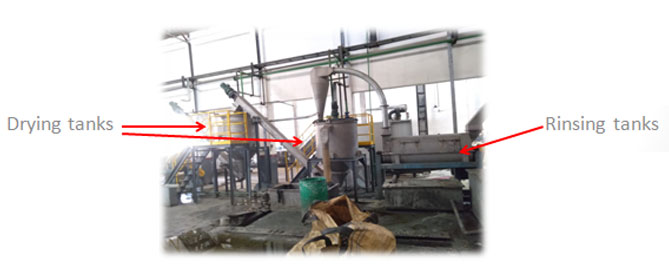
The flakes coming out of the turbo washer and centrifuge still contain a lot of residual water, caustic soda and detergent. To remove these residues the flakes need careful rinsing in fresh water.
To ensure the cleanliness and transparency of the PET flakes, high-speed machinery is used for centrifugal dewatering to reduce the moisture levels to 1 ~ 2%.
Step 9 – Fines & Dust Removal
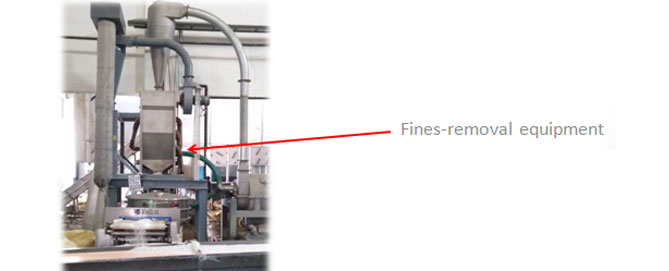
During PET flakes manufacturing, PET dust (fines) are produced. These fines have a significant impact on the next production, especially the production process of PET films and sheets.
With the help of fines-removal equipment that incorporates hot air blowing, small plastic/paper wrappers and fines are effectively removed from the PET flakes.
Step 10 – Metal Removal & Final Sorting
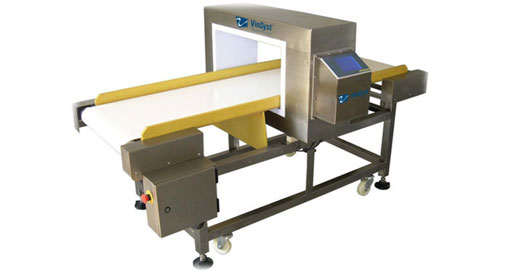
Hot-washed PET flakes are then passed through our "VINSYST" all metal separator machine which removes all ferrous and non-ferrous particles (if any) from the PET flakes.
After this, before final packing, PET flakes are manually sorted again to ensure that contaminant particles are removed and then are forwarded for final packing.
Step 11 – Packing
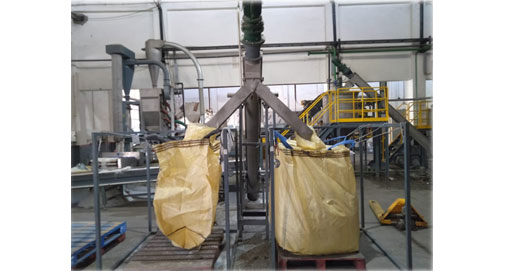
Thoroughly sorted PET flakes are then automatically packed into Jumbo bags having capacity 450kgs and are stacked for final dispatch to our customers.